Ice Retention / Guide
How to keep drinks cold without ice: pre-chill, pack tight, and pick the right phase-change temperature
Going without ice means giving up the one thing ice does for free - absorbing heat as it melts. Three things replace it: a cooler that starts cold, packs that freeze below 32°F, and a load with no air in it.
By Mike M.Updated Researched · every figure sourced
#adReader-supported: we may earn a commission if you buy through our links, at no extra cost to you. It never decides a ranking. How we rank · Disclosure
What you are giving up
Ice is not just cold. It is cold with a trick: melting a pound of ice absorbs roughly 144 BTU without the ice getting any warmer than 32°F. That latent heat is why a cooler full of ice holds temperature for days while a cooler full of cold air holds it for an hour.
So “without ice” has to mean one of two things: either you replace the latent heat with something else that changes phase — which is exactly what a gel or phase-change pack is — or you accept a much shorter window and rely on starting cold and staying shut. The honest version of this page is that the second route buys you hours, and the first buys you days.
There are good reasons to want it. No meltwater means dry cardboard, dry labels and nothing to drain into a car boot; a cooler of groceries arrives without soggy bags; a jobsite jug does not need refilling with a bag of ice every morning.
Step one: start cold
This matters more without ice than with it, because there is no reservoir to absorb the mistake. A warm cooler spends its first several hours cooling its own plastic, and with packs instead of ice that is the entire budget.
Two things, both free. Chill the drinks in a refrigerator first — a cooler is not a fridge and cannot bring a warm can down; it can only hold a cold one. Pre-chill the empty cooler overnight, with a sacrificial bag of ice or a couple of packs in it that you throw away or re-freeze before you load. Our pre-chill guide has the method and the timings.
Step two: the right freezing point
This is the part that gets skipped, and it is the whole difference between packs working and packs disappointing. Not all packs freeze at the same temperature, and the makers publish the figure.
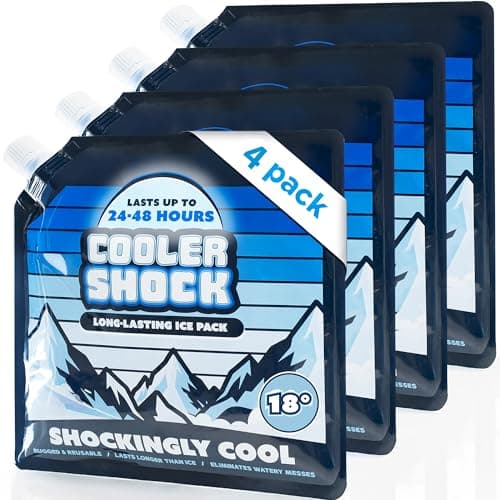
Below freezing: Cooler Shock. Its listing states an 18°F phase change point and claims safe temperatures “for up to 48 hours in a size-matched cooler.” An 18°F pack is colder than ice and holds longer, which is what you want for cans and bottles — and it is also cold enough to freeze lettuce, bruise fruit and turn beer to slush, which is exactly why the next option exists.
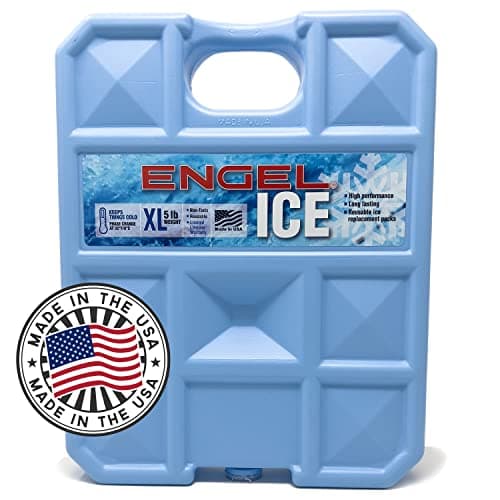
At freezing: Engel. Engel publishes 32°F for its 2.5 lb and 5 lb packs and 28°F for the 0.75 lb pack. A 32°F pack behaves like ice without the water: refrigerator-cold, nothing frozen that should not be. Engel's 5 lb pack is also the one with a limited lifetime warranty, which no other pack here matches.
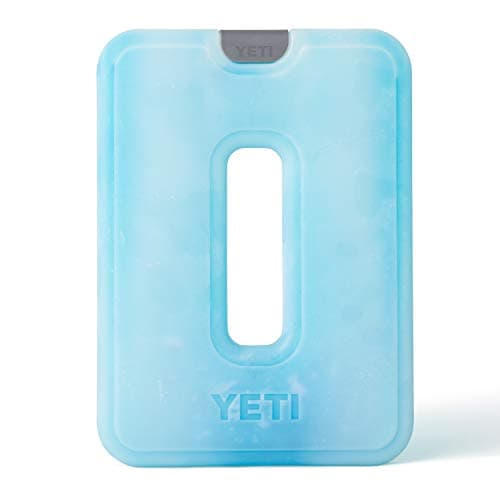
Rigid sheets. YETI's ICE Sheet is a hard-shell pack at 2.2 lb under a 5-year term, and the shape is the point: a flat sheet laid under and over the load wastes far less interior volume than a brick, which matters a great deal in a cooler you are not filling with cubes. The measured comparison across all of these is in best ice packs for coolers, and how many to use in how many ice packs do I need.
Step three: leave no air
Air is the enemy in a cooler with no ice in it. Every void is a volume you have to keep cold, it circulates heat by convection every time the lid opens, and it holds no cold of its own.
With ice, the cubes fill the gaps for you. With packs, you have to do it deliberately: pack the cooler to the lid, put packs on the top as well as the bottom — cold air falls, so a pack only on the floor leaves the top of the load warm — and fill what is left with a folded towel rather than nothing. A towel is not insulation in any meaningful sense, but it is better at not circulating than air is.
Choose the cooler size for the load rather than the trip, which is the opposite of the usual advice. A half-full 65-quart cooler with packs in it performs worse than a full 24-quart. Sizing is worked through in what size cooler do I need, and the layer order for a loaded cooler is in how to pack a cooler.
Frozen bottles, the free option
The oldest trick in this category and still the best value: freeze the drinks themselves, or freeze two or three water bottles solid and treat them as blocks.
It works because a frozen bottle is a sealed ice block — the same latent heat, none of the meltwater, and when it thaws it becomes something you drink rather than something you pour away. Freeze them standing up with an inch of headroom so the expansion has somewhere to go, and put them at the bottom and against the sides where the warmest air arrives.
The one honest limitation: a frozen bottle has a much smaller surface area than the same weight of cubes, so it cools the contents more slowly. That is a problem if you loaded warm drinks and an advantage if you loaded cold ones — it lasts longer precisely because it is not in a hurry. The block-versus-cube argument in full is in block ice vs cubed ice.
How long this actually holds
Being clear about the evidence: there is no published, controlled test comparing a pack-only cooler against an ice-filled one that we could cite, and we are not going to invent one. What there is:
Cooler Shock's own listing claims safe temperatures for up to 48 hours in a size-matched cooler — a maker claim, not a measured result. Outdoor Life's ice-pack testing ranked Cooler Shock the coldest pack it tried. And the measured cooler figures elsewhere on this site, 4 to 7 days for a rotomolded box with a full ice load, are not transferable to a pack-only load, because the latent heat available is far smaller.
The working expectation, stated as an expectation and not a measurement: a well pre-chilled, tightly packed, good-quality cooler with enough sub-freezing packs will hold drinks cold for a day comfortably and can reach two. Anything claiming a week without ice is selling something.
For drinks you carry, not store
If the question is really “how do I keep my drink cold all day without ice in it,” the answer is not a cooler at all — it is a vacuum-insulated cup, and the published figures are much better than people expect. Klean Kanteen's 32 oz TKWide claims ice for up to 59 hours on its listing; Owala and Hydro Flask both claim 24 hours cold.
A vacuum cup needs no ice to keep a cold drink cold, which is the whole trick: the drink arrives cold and almost no heat reaches it. The rankings are in best insulated water bottles and best tumblers for cold drinks, and what moves the hours is in how long do tumblers keep drinks cold.
Our picks for this
Four packs that replace ice
Two phase-change temperatures, a rigid sheet and the cheap pair with a lifetime term. Every freezing point and claim here is the maker's own; Outdoor Life's ice-pack testing is the only third-party ranking cited.
Coldest ice pack (Outdoor Life)
Cooler Shock Mid-Size Reusable Ice Packs (4-pack)
Warranty: unverified7.7/10The cold one: an 18°F phase change point and a claimed 48 hours of safe temperatures in a size-matched cooler, and the coldest pack in Outdoor Life's testing. Too cold for lettuce or glass bottles.
$29.99Amazon#ad · Price as of November 4, 2026 · Disclosure for the link to Cooler Shock Mid-Size Reusable Ice Packs (4-pack)
Best 32°F phase-change pack
Engel 5 lb Reusable Ice Pack (32°F)
Lifetime warranty7.9/10The 32°F one: refrigerator-cold rather than sub-freezing, so nothing in the cooler freezes that should not, with a limited lifetime warranty that no other pack here matches.
$29.99Amazon#ad · Price as of November 4, 2026 · Disclosure for the link to Engel 5 lb Reusable Ice Pack (32°F)
Best hard-shell ice pack
YETI ICE Sheet (Large)
5-yr warranty8.4/10The shape argument: a 2.2 lb hard-shell sheet that lies flat under and over the load instead of taking up a brick of interior volume, under YETI's 5-year term.
$25.00Amazon#ad · Price as of November 4, 2026 · Disclosure for the link to YETI ICE Sheet (Large)
Cheapest lifetime-warranty ice packs
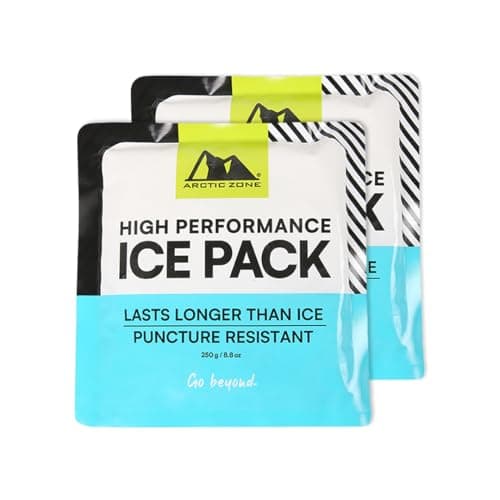
Arctic Zone Gel Ice Pack (2-pack, 250 g)
Lifetime warranty7.5/10The cheap pair, sized for lunch bags, coolers and insulated totes at 250 g each - and they carry a limited lifetime warranty, which at this price nothing else does.
$13.88Amazon#ad · Price as of November 4, 2026 · Disclosure for the link to Arctic Zone Gel Ice Pack (2-pack, 250 g)
How we scored this
What we checked before picking
Every pick on this page is built from documents you can open yourself: the maker's published capacity, insulation, dimensions and weight; the warranty term quoted from the maker's own warranty page with the date we read it; the parts catalogue, to confirm the latches, gaskets, plugs, lids and straws can actually be bought; and the third-party ice-retention tests that measured these models (OutdoorGearLab, Outdoor Life, Treeline, Outside, Gear Patrol), credited to the publisher that ran them. Every figure links to where it came from, so you can check the pick before you buy it.
Scores are editorial judgments built from that documented research. Commissions never set a score or decide a pick. The rubric and its weights are published.
Questions
Frequently asked
How do you keep drinks cold without ice?
Chill the drinks in a fridge first, pre-chill the cooler overnight, replace the ice with frozen phase-change packs, and pack the cooler full so there is no air left to cool. Put packs on top as well as underneath, because cold air falls.
How long do ice packs keep drinks cold?
Cooler Shock claims up to 48 hours of safe temperatures in a size-matched cooler, which is a maker claim rather than a measured result. Expect a day comfortably from a well pre-chilled, tightly packed cooler, and treat two days as the ceiling.
Are ice packs better than ice?
Different, not better. Packs leave no meltwater and can freeze below 32°F, so they hold longer per pound. Ice has far more total latent heat for the money, fills every void, and cools warm drinks much faster. For a multi-day trip with warm contents, use ice; for a dry, pre-chilled load, use packs.
Can I use frozen water bottles instead of ice?
Yes, and it is the best-value option: a sealed ice block with no meltwater that becomes drinking water as it thaws. Freeze them upright with an inch of headroom and place them low and against the walls.
Which ice pack temperature should I buy?
18°F for drinks only — colder and longer-lasting, but it will freeze produce and can slush beer. 32°F if food is going in as well, which is what Engel publishes for its 2.5 lb and 5 lb packs.
Does a half-empty cooler stay cold without ice?
Much less well. Air holds no cold and circulates heat every time the lid opens. With packs rather than ice there is nothing filling the voids for you, so size the cooler to the load and fill what is left with a towel.
Keep reading
Related on Chill & Chest
- Best ice packs for coolersThe ranked packs, with freezing points.
- How many ice packs do I needThe ratio, by cooler size.
- How to pre-chill a coolerThe free step that matters most here.
- Block ice vs cubed iceWhy a frozen bottle behaves like a block.
- How to keep ice longer in a coolerThe version of this with ice in it.
- Best tumblers for cold drinksFor a drink you carry rather than store.
Receipts
Sources
- Amazon — Cooler Shock 4-Pack Mid-Size Reusable Ice Packs listing, model Shock-1/18F-Dry: "An 18°F phase change point keeps contents colder longer than standard ice, maintaining safe temps for up to 48 hours in a size-matched cooler", "Replaces 5-6 lbs of Ice Per Pack", 10 × 10 × 1 in each, add water and freeze (read 2026-10-03)
- Outdoor Life — "Best Ice Packs for Coolers", June 12, 2025, 36-hour freeze test (read 2026-09-21)
- Engel — Cooler Packs 32°F & 28°F product page (read 2026-09-21)
- Amazon — YETI ICE Sheet Refreezable Reusable Cooler Ice Pack, Large: "YETI ICE is legendary for making your regular ice last for hours, and YETI THIN ICE is no different", "nearly 50% slimmer than its predecessor and engineered to completely replace the need for regular ice inside your Hopper Soft Coolers and Daytrip Lunch Bag and Box", 2.2 lb (read 2026-10-03)
- YETI — Warranty Information (YETI's warranty page as republished by Acme Tools, an authorized YETI dealer; read 2026-09-21)
- Amazon — Arctic Zone Gel Ice Pack (2 packs, 250 g each) listing, model 5-59105-00-0E: "sized to fit lunch bags, coolers and insulated totes", "Each ice pack weighs 250 grams", puncture-resistant, non-toxic gel, declared "Limited Warranty" (read 2026-10-03)
- Arctic Zone / Titan — Warranty page (read 2026-09-21)
- Amazon — Klean Kanteen TKWide Insulated Bottle 32 oz listing, model 1010112: shipped with the "Twist Cap with a built-in reusable stainless steel straw", "keeps beverages iced for up to 59 hours with Climate Lock technology", 1.14 lb (read 2026-10-03)
- Owala — FreeSip product page (read 2026-09-21)
- Hydro Flask — 32 oz Wide Mouth product page, Wayback Machine capture 2026-09-12 (hydroflask.com blocks direct fetches; read 2026-09-21)
Specs come from the maker's own product pages (linked on every product), warranty terms from the maker's warranty page with the date we read it, and ice-retention measurements are attributed to whoever measured them. Prices are the live Amazon price with the date they were last checked. Where a figure isn't published anywhere, the page says so. Read the full method.