Ice Retention / Guide
Block ice vs cubed ice: which one actually keeps a cooler cold longer
Block lasts longer, cubes cool faster, and nobody publishes a controlled test of the difference. Here is what the geometry forces, what two cooler makers advise in writing, and the packing order that uses both.
By Mike M.Updated Researched · every figure sourced
#adReader-supported: we may earn a commission if you buy through our links, at no extra cost to you. It never decides a ranking. How we rank · Disclosure
The short version
A pound of ice absorbs the same amount of heat whichever shape it is in. The shape only changes how fast that happens. A block presents a small skin to the warm air inside your cooler and keeps its own core shielded behind that skin, so it gives up its cold slowly. A bag of cubes is almost all skin, so it gives up its cold quickly. Everything below follows from that one fact.
So the useful question is not which ice is better, it is what you are asking the ice to do. Keeping a packed cooler cold across a long weekend is a slow job and wants block. Dropping the temperature of six warm cans before the first guest arrives is a fast job and wants cubes. A cooler on a three-day trip has to do both, which is exactly why the two makers quoted below tell you to carry both rather than to choose.
Why block lasts longer
Chilly Moose, a cooler maker, states the mechanism plainly: “a single large block has far less exposed surface area per unit of mass than the same weight of cubes.” Melting happens at the boundary between the ice and everything warmer than it. Shrink that boundary and you slow the melt, even though the total amount of cold stored in the ice has not changed at all.
There is a second effect that matters just as much in practice: a block is self-insulating. Its outside melts first, and the meltwater and remaining ice shield the core until last. A cube has no core worth protecting. That is why a cooler loaded with cubes tends to go from mostly ice to all water rather suddenly, while a block shrinks steadily and leaves you something solid on the last morning.
What cubes are better at
Cubes are not the budget option, they do a different job. Chilly Moose again: “Cubes have lots of surface area, so they pull heat out of warm drinks and food quickly and pack tightly into every gap.” Both halves of that sentence earn their place. The fast heat transfer is what you want when the contents go in warm, and the packing matters because air is the enemy. Every void in a loaded cooler is a pocket of warm air that has to be cooled, and then cooled again every time the lid opens.
A block alone cannot close those voids — it is a brick in a box. That is the practical argument against going all-block: you trade a slower melt for a cooler full of air gaps, and the gaps give back part of what the block saved. A bag of cubes poured over and around a block fixes that for a couple of dollars.
Cubes are also the right tool for the step most people skip. Pre-chilling is a fast-cooling job, so it is a cube job, and on its own it is worth more than the ice-type decision: how to pre-chill a cooler has the method and the timings.
What the makers advise
Neither maker claims a multiplier, and neither tells you to pick a side. Two independent sources agreeing on the same division of labor is the most reliable thing on this page.
Why we will not give you a multiplier
You will find “block ice lasts twice as long” repeated all over the internet. We cannot source it. The ice-retention tests we cite elsewhere on this site — OutdoorGearLab’s cooler table, and Outdoor Life’s head-to-head, which fills each cooler to one third of its capacity with ice at a 60–70°F ambient — are built to compare coolers, so they deliberately hold the ice type constant instead of varying it. A controlled block-versus-cube test with the same cooler, the same weight of ice, the same ambient temperature and a published protocol is not something we have found from anyone.
So here is the honest shape of the claim: the direction is certain and rests on geometry, two makers agree on that direction, and the size of the gain is unmeasured. It depends on your cooler, the size of your block, the ambient temperature and how often you open the lid. Anyone quoting you a precise figure for your cooler is guessing. If that standard of evidence is why you are here, how ice retention tests work explains what a citable protocol looks like and why so few exist.
The packing order
Both makers describe the same stack, so this is the version to use.
- Pre-chill the empty cooler with sacrificial cubes, 12–24 hours ahead, then pour that water out. A warm cooler spends the first several pounds of your trip ice cooling its own walls.
- Block on the bottom. This is the mass that has to survive to the last day. Frozen jugs count, and have the advantage of turning into drinking water as they go.
- Pre-chilled food and drinks in the middle, packed tight, with the warmest items nearest the ice. Nothing goes in warm if you can avoid it.
- Cubes over the top and into every gap. Cold falls, and air gaps are the leak. Aim for Elite Cooler’s 2:1 ice-to-contents ratio by volume.
One more thing both makers imply and most people get wrong: do not drain the meltwater. Cold water conducts cold to your contents far better than the warm air that would replace it. The full list of habits that actually move the needle is in how to keep ice longer in a cooler.
Making block ice, and the alternative to both
Block ice is harder to buy than it used to be. Ice houses, bait shops and some grocery stores still carry it; otherwise you make it, and it costs nothing but freezer time. Fill a clean rigid container — an ice cream tub, a small plastic bin, a washed milk jug — about three quarters full so the water has room to expand, and freeze it solid for a day or two. A jug is the most useful shape: it is rigid, it will not flood your food as it melts, and what it leaves behind is drinkable.
There is a third option, and for anything shorter than a weekend it is usually the right one: a hard ice pack. A pack is a sealed block that never waterlogs your sandwiches, refreezes indefinitely, and in the case of a phase-change pack holds a temperature below freezing while it thaws. The three below are the ones we can cite published figures for, and they are covered in full in best ice packs for coolers.
Our picks for this
Sealed blocks, if you would rather not carry water
A hard pack is a block that does not melt into your food. Prices are set by Amazon and shown live on the buttons.
Best ice pack overall
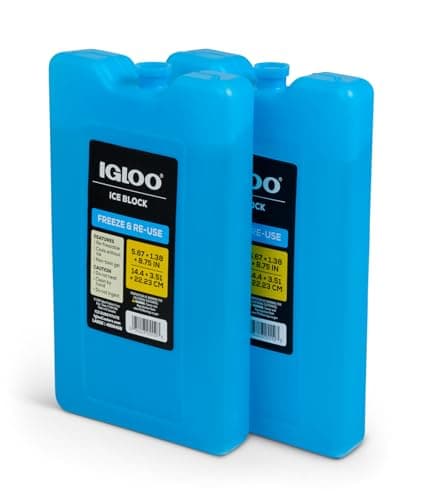
Igloo MaxCold Ice Block (Large, 2-pack)
90-day warranty8.0/10The cheapest way to put a sealed block in the bottom of a cooler, in exactly the role the makers assign to block ice.
$14.99Amazon#ad · Price as of October 9, 2026 · Disclosure for the link to Igloo MaxCold Ice Block (Large, 2-pack)
Best hard-shell ice pack
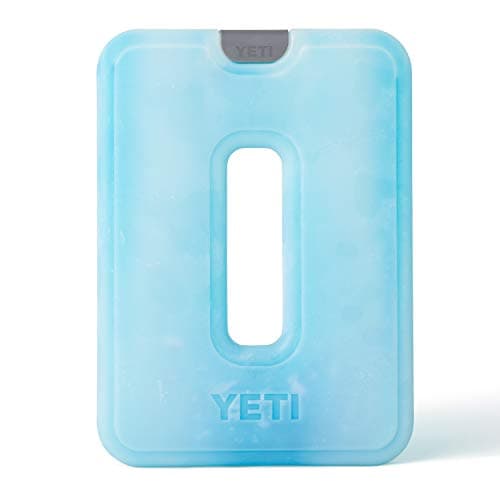
YETI ICE Sheet (Large)
5-yr warranty8.4/10Slim enough to lie flat over or under the contents rather than stealing the space your food needs.
$25.00Amazon#ad · Price as of October 9, 2026 · Disclosure for the link to YETI ICE Sheet (Large)
Coldest ice pack (Outdoor Life)
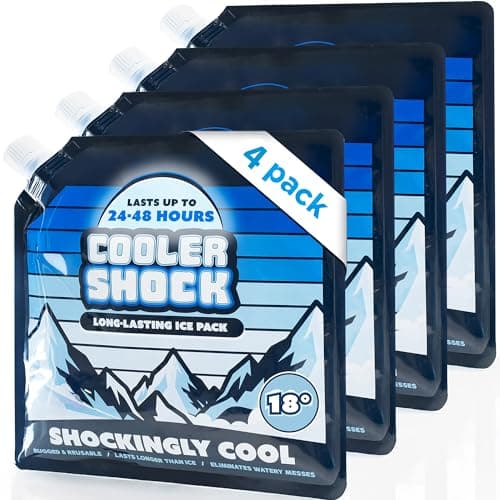
Cooler Shock Mid-Size Reusable Ice Packs (4-pack)
Warranty: unverified7.7/10A phase-change pack: it thaws at 18 degrees Fahrenheit rather than 32, so it holds a colder floor than water ice of any shape.
$29.99Amazon#ad · Price as of October 9, 2026 · Disclosure for the link to Cooler Shock Mid-Size Reusable Ice Packs (4-pack)
If you are going the other way — colder than ice rather than longer than ice — read dry ice in a cooler first, including which coolers tolerate it and the ventilation rule you must not break.
How we scored this
What we checked before picking
Every pick on this page is built from documents you can open yourself: the maker's published capacity, insulation, dimensions and weight; the warranty term quoted from the maker's own warranty page with the date we read it; the parts catalogue, to confirm the latches, gaskets, plugs, lids and straws can actually be bought; and the third-party ice-retention tests that measured these models (OutdoorGearLab, Outdoor Life, Treeline, Outside, Gear Patrol), credited to the publisher that ran them. Every figure links to where it came from, so you can check the pick before you buy it.
Scores are editorial judgments built from that documented research. Commissions never set a score or decide a pick. The rubric and its weights are published.
Corrections & updates
- First published. Chilly Moose's ice-types guidance and Elite Cooler's Pelican ice-retention guidance read 2026-10-09. No controlled block-versus-cube test with a published protocol was found, so the page says so rather than repeating the common 'twice as long' claim.
Questions
Frequently asked
Does block ice really last longer than cubed ice?
Yes, and the reason is geometry rather than anything about the water: a block has far less exposed surface area per pound than the same weight of cubes, so it melts more slowly, and its own core stays shielded until last. We will not quote you a multiplier, because no controlled block-versus-cube test with a published protocol exists that we could cite.
Is cubed ice ever the better choice?
Often. Cubes transfer heat faster, so they chill warm contents and pre-chill an empty cooler far more effectively, and they pack into the gaps a block leaves. Elite Cooler specifically recommends “10–20 pounds of ice cubes” for a 12–24 hour pre-chill before the trip ice goes in.
What ratio of ice to food should I use?
Elite Cooler’s guidance is the 2:1 rule: “You should always use twice as much ice as you have goods in your cooler.” Most people under-ice by a wide margin and then blame the cooler.
How do I make block ice at home?
Freeze water in a rigid container — a washed milk jug, an ice cream tub, a small plastic bin — filled about three quarters full so it has room to expand, for a day or two. Jugs are the most useful shape: they do not flood the cooler as they melt, and the meltwater is drinkable.
Should I use block ice or an ice pack?
For a lunch cooler or a day trip, a pack: it is a sealed block that never waterlogs your food and refreezes for the next trip. For a multi-day cooler you usually want real block ice for sheer mass, with packs filling out the load. A phase-change pack such as Cooler Shock is the exception, because it holds a temperature below freezing as it thaws.
Should I drain the meltwater?
No. Cold meltwater conducts cold to your contents far better than the warm air that would replace it, so draining a cooler mid-trip shortens its ice life. Drain it only when you need the weight gone or the food out of the water.
Where do these numbers come from?
The mechanism and the packing order are quoted from two cooler makers’ own published guidance, Chilly Moose and Elite Cooler (a Pelican dealer), both read on 2026-10-09. We have not run a block-versus-cube test and do not claim to have.
Keep reading
Related on Chill & Chest
- How to keep ice longer in a coolerEvery habit that moves the needle.
- How to pre-chill a coolerThe cube job you should not skip.
- Best ice packs for coolersSealed blocks, with published figures.
- Dry ice in a coolerColder than ice, with rules.
- Cooler ice retention chartEvery measured hour figure we can cite.
- How ice retention tests workWhy a citable protocol is rare.
- Best coolers for ice retentionThe box matters more than the ice.
Receipts
Sources
- Chilly Moose — "Ice Packs vs Loose Ice vs Block Ice: What Keeps a Cooler Cold Longest": "a single large block has far less exposed surface area per unit of mass than the same weight of cubes"; "Cubes have lots of surface area, so they pull heat out of warm drinks and food quickly and pack tightly into every gap"; block ice for "Multi-day trips, the long-haul base layer", cubes for "Day trips, fast chilling, filling gaps" (read 2026-10-09)
- Elite Cooler (Pelican cooler dealer) — "Cooler Use 101: Get the Best Ice Retention from Your Cooler": "You should always use twice as much ice as you have goods in your cooler", pre-chill with "10-20 pounds of ice cubes" for "12-24 hours", then "layer the bottom with block ice, and pack your cooler, being sure to add layers of cubed ice and fill in any open spaces with more cubed ice" (read 2026-10-09)
- OutdoorGearLab — "The Best Coolers of 2026", updated July 17, 2026, comparison table (read 2026-09-21)
- Outdoor Life — "We Tested the Best Coolers Head to Head", May 28, 2026, one-third-capacity ice test (read 2026-09-21)
- Outdoor Life — "Best Ice Packs for Coolers", June 12, 2025, 36-hour freeze test (read 2026-09-21)
- Amazon — Igloo MaxCold Ice Block (2 pieces, Large) listing, model 00025550: "Non-toxic Ultratherm gel delivers extended cooling performance", 8.75 × 5.67 × 1.38 in each, 2.03 lb for the pair, and Igloo's 90-day defect warranty quoted on the listing (read 2026-10-03)
- Amazon — YETI ICE Sheet Refreezable Reusable Cooler Ice Pack, Large: "YETI ICE is legendary for making your regular ice last for hours, and YETI THIN ICE is no different", "nearly 50% slimmer than its predecessor and engineered to completely replace the need for regular ice inside your Hopper Soft Coolers and Daytrip Lunch Bag and Box", 2.2 lb (read 2026-10-03)
- Amazon — Cooler Shock 4-Pack Mid-Size Reusable Ice Packs listing, model Shock-1/18F-Dry: "An 18°F phase change point keeps contents colder longer than standard ice, maintaining safe temps for up to 48 hours in a size-matched cooler", "Replaces 5-6 lbs of Ice Per Pack", 10 × 10 × 1 in each, add water and freeze (read 2026-10-03)
Specs come from the maker's own product pages (linked on every product), warranty terms from the maker's warranty page with the date we read it, and ice-retention measurements are attributed to whoever measured them. Prices are the live Amazon price with the date they were last checked. Where a figure isn't published anywhere, the page says so. Read the full method.