Ice Retention / Guide
How to keep a cooler cold in the sun: shade first, then color, then cold mass
Direct sun is the only condition where a cooler's color measurably changes the answer - a black lid measured 174F against 109F on an identical white one. Here is what to do about it, ranked by how much each move is worth.
By Mike M.Updated Researched · every figure sourced
#adReader-supported: we may earn a commission if you buy through our links, at no extra cost to you. It never decides a ranking. How we rank · Disclosure
The order that pays
Five moves, in descending order of what each is actually worth on a hot day: get the cooler out of direct sun; fill it so there is cold mass instead of air; use block ice or frozen packs rather than only cubes; open it as few times as possible; and raise it off hot ground. Color is a buying decision rather than a packing one, but it sits between the first and second item in size.
Everything on this list is free, which is the point. A $350 cooler in full sun with a one-third load and six lid openings an hour will lose to a $95 cooler under a towel, packed full, opened twice.
What sun actually does
Two readings of that, both useful. The headline is that sunlight is worth up to two days of ice on a week-long hold. The more important one is the mechanism: sun heats the lid, the lid heats the air inside, and the air melts the ice. Everything below attacks one of those three steps.
One more finding worth holding on to: the water temperature inside was identical across all three colors until the ice was gone. Melting ice pins a cooler at about 32°F no matter what the lid is doing. You are protecting a budget of ice, not a temperature — which is the same idea behind every ice test on this site.
1. Shade, and anything that acts like shade
If the lid never gets above air temperature, the sun has been removed from the equation entirely. A tree, a canopy, the shaded side of a vehicle or a tarp all do it. So does a wet towel laid over the lid, which adds evaporative cooling on top of shade — it is the oldest trick in the category and still the best-value one.
If none of that is available, make shade: a space blanket, a light-colored tarp or even a cardboard sheet propped above the lid with an air gap under it. The air gap matters, because a cover lying flat on a hot lid conducts heat straight in. In a truck bed, park so the cab shades the cooler and move it when the sun comes round.
On a boat deck there is no shade to find, which is why boat coolers are white and why the color decision matters more there than anywhere else.
2. Color, if you are still buying
You cannot repaint a cooler — polyethylene does not hold paint — so color is only actionable at purchase. For a cooler that will live in the sun, buy white or sand: up to two measured days on a week-long hold, and a lid you can touch barefoot. For a cooler that lives in shade, buy whatever hides scuffs best, because in shade the color effect measured under 1°F.
The color page has the whole test and the trade against hiding damage. The only sun-related change you can make to a cooler you already own is a cover, which is the same move as shade.
3. More cold mass, less air
Air is the enemy in every ice test, and it is the enemy twice over in the sun, because hot air above the ice is what the lid is heating. Fill ratio is the single biggest variable in cooler testing: the same YETI Roadie 48 measured 6.8 days sealed and brim-full at OutdoorGearLab and 115 hours at a one-third ice load outdoors in Outdoor Life's test.
So fill the cooler. Makers publish the target as a ratio: YETI rates the Tundra 45 at 28 cans at a 2:1 ice-to-can ratio and the Tundra 65 at 42 cans at the same ratio. Twice as much ice as contents, by volume. Fill the leftover space with anything cold — more ice, frozen water bottles, a towel — rather than leaving it as air. How to pack a cooler has the layer order, and pre-chilling stops the first bag of ice being spent cooling the plastic.
Block ice over cubes, for the same reason: less surface area per pound, so it melts slower. Cubes fill the voids that block ice leaves — block vs cubed covers the mix. And do not drain the meltwater: cold water is still cold mass, and draining it replaces it with warm air. Drain it only when you need the space or the trip is over.
Our picks for this
The cold mass to use in the sun
Frozen mass that does not turn into water you have to drain, chosen for a cooler that is going to be worked hard in heat.
Best ice pack overall
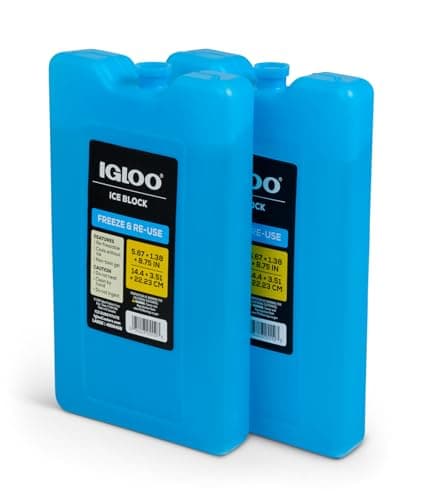
Igloo MaxCold Ice Block (Large, 2-pack)
90-day warranty9.5/10Outdoor Life's Best Overall ice pack: 5°F out of the freezer, 31°F after 4 hours on a counter. Ultratherm gel blocks in the Large size, now sold two to a pack, with a 90-day term.
$14.99Igloo MaxCold Ice Block (Large, 2-pack) on Amazon#ad · Price as of November 9, 2026 · Disclosure for the link to Igloo MaxCold Ice Block (Large, 2-pack)
Coldest ice pack (Outdoor Life)
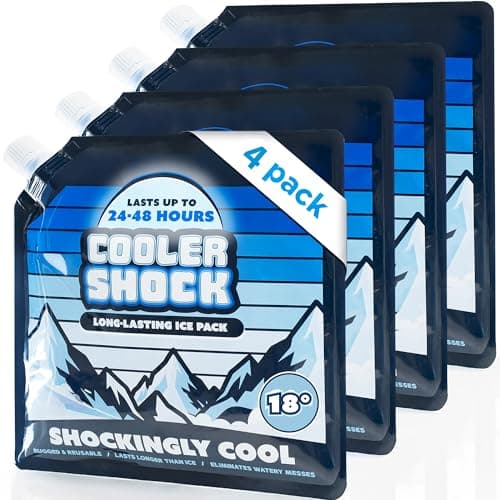
Cooler Shock Mid-Size Reusable Ice Packs (4-pack)
Warranty: unverified9.4/10Phase-change packs sized to be a layer rather than a lump - the way to fill dead air at the top of a load with cold instead of warm air.
$29.99Cooler Shock Mid-Size Reusable Ice Packs (4-pack) on Amazon#ad · Price as of November 9, 2026 · Disclosure for the link to Cooler Shock Mid-Size Reusable Ice Packs (4-pack)
Best hard-shell ice pack
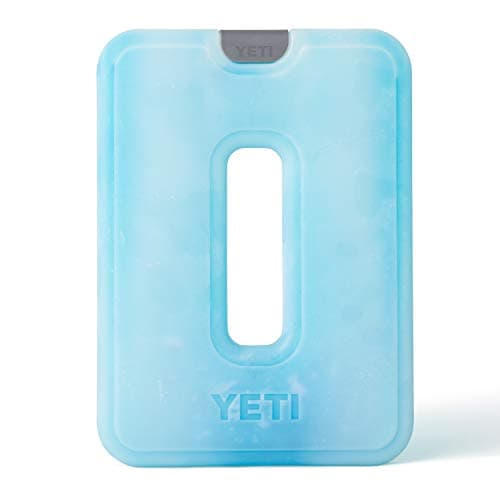
YETI ICE Sheet (Large)
5-yr warranty9.6/10A flat sheet that lies on top of the contents directly under the lid, which is exactly where the sun's heat arrives.
$25.00YETI ICE Sheet (Large) on Amazon#ad · Price as of November 9, 2026 · Disclosure for the link to YETI ICE Sheet (Large)
4. Stop opening the lid
Every opening dumps the cold air and takes in 95°F air, and in the sun that air is immediately reheated by the lid. On a hot day this is the difference between a cooler that lasts the weekend and one that does not.
The standard fix is two coolers: drinks in one that gets opened constantly, food in one that gets opened twice a day. If you only have one, pack the drinks at the top so the opening is shallow and brief, and use a soft cooler as the drinks bag. Keeping food cold while camping treats this as the organising principle, because food safety depends on the cooler that is not being opened.
5. Get it off the hot surface
A cooler sitting on sand at 130°F, on a black truck bed liner or on asphalt is being heated from below through its thinnest wall — the base is almost always the least insulated part. Put something between them: a towel, a wooden pallet, a camp mat, the shaded side of a cooler rack.
On a beach, dig the cooler in a few inches: the sand below the surface is dramatically cooler than the top, and burying the base also shades it. Beach coolers covers that and the rest of the sand problem, and the full ice-retention checklist puts all of these moves in one list.
How we scored this
What we checked before picking
Every pick on this page is built from documents you can open yourself: the maker's published capacity, insulation, dimensions and weight; the warranty term quoted from the maker's own warranty page with the date we read it; the parts catalogue, to confirm the latches, gaskets, plugs, lids and straws can actually be bought; and the third-party ice-retention tests that measured these models (OutdoorGearLab, Outdoor Life, Treeline, Outside, Gear Patrol), credited to the publisher that ran them. Every figure links to where it came from, so you can check the pick before you buy it.
Scores run from 8.4 to 10: 9.5–9.8 is category-defining, 9.0–9.4 outstanding, and 8.4–8.9 excellent and strongly recommended. Nothing below 8.4 is listed here — a product that cannot earn 8.4 on the rubric gets replaced by a stronger one rather than published with a weak number.
Scores are editorial judgments built from that documented research. Commissions never set a score or decide a pick. The rubric and its weights are published.
Corrections & updates
- First published. Sun and shade figures quoted from Outdoor Empire's three-cooler test, read 2026-11-10; fill-ratio figures from OutdoorGearLab and Outdoor Life as already dated in the registry.
Questions
Frequently asked
How do you keep a cooler cold in direct sunlight?
Shade it — a canopy, a tarp with an air gap, or a wet towel over the lid — then fill it to a 2:1 ice-to-contents ratio, use block ice, keep the lid shut and raise it off hot ground. Sunlight was worth up to two days of ice in Outdoor Empire's three-cooler test.
Does cooler color matter in the sun?
Yes, and only in the sun. An identical black cooler's lid measured 174°F against 109°F for white, internal air ran about 10°F warmer, and ice lasted about 5 days against 7. In shade the same coolers differed by less than 1°F.
Should I put a wet towel over my cooler?
It is the best free move available: it shades the lid and adds evaporative cooling. Keep it damp, and if you use a solid cover instead, leave an air gap so it is not conducting heat into the lid.
Should I drain the melted ice water?
Not until you need the space. Cold meltwater is still cold mass; draining it replaces it with warm air, which is the thing you are trying to get rid of. The exception is raw meat or fish water, which should go for hygiene.
Does burying a cooler in sand help?
Yes. Sand a few inches down is much cooler than the surface, and burying the base shades the least-insulated wall of the cooler. Combine it with a cover over the lid.
Where do these numbers come from?
The sun and shade figures are Outdoor Empire's published test of three identical Blue Coolers Ice Vault 60s, read 2026-11-10. The 2:1 ratio and can counts are YETI's own published specification, and the fill-ratio comparison is OutdoorGearLab's and Outdoor Life's results for the same cooler. This site does not run ice tests.
Keep reading
Related on Chill & Chest
- How to keep ice longerThe full checklist, sun or no sun.
- Cooler color paletteThe whole color test, and the trade.
- How to pre-chill a coolerStop spending the first bag on the plastic.
- How to pack a coolerLayer order and the 2:1 ratio.
- Best beach coolersSun, sand and the base of the cooler.
- Best ice packs for coolersCold mass that comes out dry.
Receipts
Sources
- Outdoor Empire — "Tested: Does Cooler Color Really Matter for Ice Retention?": three identical Blue Coolers Ice Vault 60-quart wheeled rotomolded coolers in white, blue and black (the black one made specially for the test). In direct sun with daily highs from the mid-90s to over 100°F the black lid peaked at 174°F against 109°F for white at the same moment, internal air peaked about 10°F warmer in black and about 8°F warmer in blue than in white, and ice lasted about 5 days (black), 6 days (blue) and 7 days (white). In shade at low-70s ambient all three lasted 3 days, lid temperatures matched air temperature and internal air varied by less than 1°F: "when coolers are kept in the shade, color has no significant impact on performance." Water temperature was identical across all three colors until the ice was gone (read 2026-11-10)
- Blue Coolers — 60 Quart Ice Vault Roto-Molded Cooler with Wheels product page: "True 60 Quart Interior Volume", "50-55 cans" at a 2:1 ice ratio, "36.5 lbs" empty, "Up to 10 days ice retention", and "90-Day 100% Satisfaction Money-back Guarantee and 5-year Manufacturer's parts and construction defect warranty"; in stock at $319.99 (read 2026-10-09)
- OutdoorGearLab — "The Best Coolers of 2026", updated July 17, 2026, comparison table (read 2026-09-21)
- Outdoor Life — "We Tested the Best Coolers Head to Head", May 28, 2026, one-third-capacity ice test (read 2026-09-21)
- OutdoorGearLab — YETI Roadie 48 review, April 24, 2024 (read 2026-09-21)
- L.L.Bean (authorized YETI dealer) — YETI Tundra 45 product page (read 2026-09-21)
- L.L.Bean (authorized YETI dealer) — YETI Tundra 65 product page (read 2026-09-21)
- Igloo — MaxCold Ice Large Freeze Block product page (read 2026-09-21)
- Amazon — Cooler Shock 4-Pack Mid-Size Reusable Ice Packs listing, model Shock-1/18F-Dry: "An 18°F phase change point keeps contents colder longer than standard ice, maintaining safe temps for up to 48 hours in a size-matched cooler", "Replaces 5-6 lbs of Ice Per Pack", 10 × 10 × 1 in each, add water and freeze (read 2026-10-03)
- Amazon — YETI ICE Sheet Refreezable Reusable Cooler Ice Pack, Large: "YETI ICE is legendary for making your regular ice last for hours, and YETI THIN ICE is no different", "nearly 50% slimmer than its predecessor and engineered to completely replace the need for regular ice inside your Hopper Soft Coolers and Daytrip Lunch Bag and Box", 2.2 lb (read 2026-10-03)
- Elite Cooler (Pelican cooler dealer) — "Cooler Use 101: Get the Best Ice Retention from Your Cooler": "You should always use twice as much ice as you have goods in your cooler", pre-chill with "10-20 pounds of ice cubes" for "12-24 hours", then "layer the bottom with block ice, and pack your cooler, being sure to add layers of cubed ice and fill in any open spaces with more cubed ice" (read 2026-10-09)
Specs come from the maker's own product pages (linked on every product), warranty terms from the maker's warranty page with the date we read it, and ice-retention measurements are attributed to whoever measured them. Prices are the live Amazon price with the date they were last checked. Where a figure isn't published anywhere, the page says so. Read the full method.