Ice Retention / Guide
How to keep food cold while camping: plan the menu, not just the cooler
Past about three nights the cooler stops being the variable and the plan takes over. Freeze the back half of the menu, keep drinks out of the food cooler, and know which day each thing has to be eaten by.
By Mike M.Updated Researched · every figure sourced
#adReader-supported: we may earn a commission if you buy through our links, at no extra cost to you. It never decides a ranking. How we rank · Disclosure
The 40°F line, and where it comes from
Every ice-retention figure on this site is reported two ways — hours below 40°F and hours below 50°F — because that is how OutdoorGearLab reports its test. The YETI Tundra 65 held 4.8 days below 40°F and 5.3 days below 50°F; the RTIC 65 Ultra-Tough held 5.5 and 6.1. The gap between those two columns is the gap between “food still safe” and “drinks still cold”, and it is usually around half a day.
So when you read a cooler's headline number, check which column it came from. A cooler advertised on its 50°F figure will let your food out of the safe zone roughly twelve hours before the number says so. How cooler ice retention tests work explains the protocols, and the ice retention chart is the sourced table of both columns.
Two coolers, not one big one
This is the highest-value change you can make and it costs less than upgrading the cooler. Drinks get fetched twenty or thirty times a day; food gets touched three times. Share one box and the food pays for every beer, because the cold air falls out of the open lid each time.
The food cooler should be the good one, packed to the brim and opened on a schedule. The drinks cooler can be anything — a soft cooler, a cheap chest, a hard-liner bag — kept in the shade and re-iced freely. Best soft coolers and best small coolers cover that second box, and best coolers for camping sorts the first one by how many nights you are out.
Order the menu by survival time
Write the trip's meals in the order the ingredients fail, not the order you feel like eating them. Roughly:
Nights one and two: anything raw and loose — fish, chicken, ground meat, shellfish, cut fruit, dairy in opened packaging. These are the items whose window is the 40°F column, and they should be gone before you are relying on the second half of the ice.
Nights three and four: vacuum-sealed or frozen-then-thawed meat, hard cheeses, eggs, sealed condiments, vegetables that do not mind being cold and wet. Hard containers, not bags — packaging that holds its shape keeps its contents out of the meltwater.
Night five onward: shelf-stable food. Cured meat, pasta, rice, tinned fish, oil, dried goods. Past five nights the honest plan is to stop asking the cooler to carry the menu and let the pantry take over.
Freeze the back half of the menu
The best ice you can carry is food you were taking anyway. Chilli, curry, bolognese and stew frozen flat in bags are cold mass on the way out and dinner on day four, and they take up space that would otherwise be air. Frozen meat does the same job. Lay them on the bottom layer with the block ice, where the cold falls through everything above.
Then protect the produce from your own cold mass. This is where phase-change temperature matters: Engel publishes 32°F for its 2.5 lb and 5 lb Cooler Packs and 28°F for the 0.75 lb pack, and Cooler Shock publishes an 18°F phase change. A sub-freezing pack will freeze lettuce, eggs and beer solid against it; a 32°F pack holds the cooler at refrigerator temperature instead. Put the hard, cold packs against the meat and the 32°F packs near the produce. How many ice packs do I need works out the count, and how to pack a cooler is the layer order.
Past five nights
Three options, in order of how much they cost you.
Re-ice. The simplest and the one every long trip actually uses. Plan the route past a shop or a campground ice machine on day three, and buy block rather than cubed if you can get it — block ice vs cubed ice sets out the real trade.
Dry ice, in a cooler rated for it. OutdoorGearLab lists the YETI Tundra Haul as dry-ice compatible and Engel states its High Performance rotomolded coolers are too; plenty of coolers are not, and dry ice in an unrated cooler can craze the liner or build pressure behind a sealed gasket. Dry ice in a cooler covers the handling and the venting.
A bigger cooler. Last, not first. More volume means more ice but also more surface area and more weight to pre-chill, and a half-empty large cooler performs worse than a full smaller one. Fill what you have before you buy more — how to keep ice longer in a cooler is the full list of the free wins.
Our picks for this
What this plan runs on
A food cooler with the interior to layer in, a 32°F pack that will not freeze the produce, and a second box for drinks. Prices come from the live Amazon listing.
Best Tundra for a week of camping
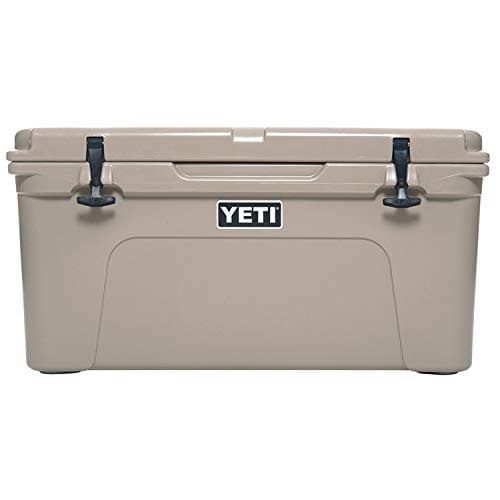
YETI Tundra 65
5-yr warranty7.1/10The food cooler: 4.8 measured days below 40°F, up to three inches of lid insulation, a 23-inch interior, a 5-year term and every wear part sold as a YETI replacement part.
$395.00Amazon#ad · Price as of October 10, 2026 · Disclosure for the link to YETI Tundra 65
Best 32°F phase-change pack
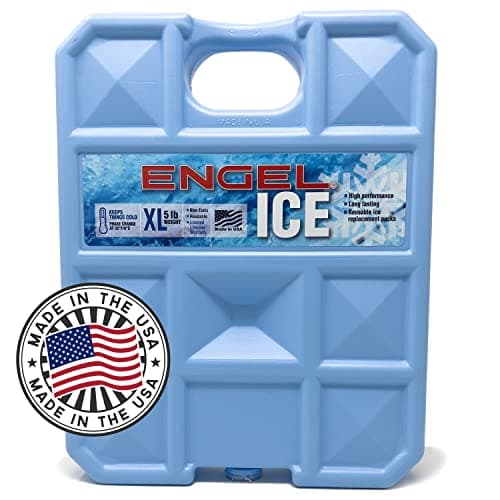
Engel 5 lb Reusable Ice Pack (32°F)
Lifetime warranty7.9/10The produce-safe pack: Engel publishes a 32°F phase change for its 2.5 lb and 5 lb packs, so it holds the cooler at fridge temperature instead of freezing what it touches. Limited lifetime warranty.
$29.99Amazon#ad · Price as of October 10, 2026 · Disclosure for the link to Engel 5 lb Reusable Ice Pack (32°F)
Best soft cooler with a hard liner
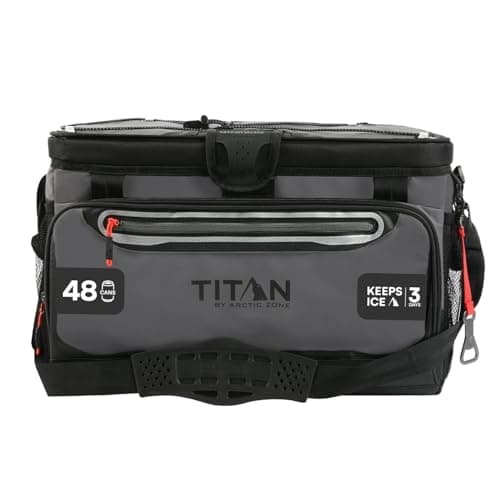
Titan by Arctic Zone 48 Can Zipperless HardBody Cooler
Lifetime warranty6.6/10The drinks box: 48 cans, a removable FDA-compliant hard liner with a shelf that lifts out, a zipperless flip lid, 4.54 lb, and Arctic Zone's limited lifetime term on soft goods.
$86.99Amazon#ad · Price as of October 10, 2026 · Disclosure for the link to Titan by Arctic Zone 48 Can Zipperless HardBody Cooler
How we scored this
What we checked before picking
Every pick on this page is built from documents you can open yourself: the maker's published capacity, insulation, dimensions and weight; the warranty term quoted from the maker's own warranty page with the date we read it; the parts catalogue, to confirm the latches, gaskets, plugs, lids and straws can actually be bought; and the third-party ice-retention tests that measured these models (OutdoorGearLab, Outdoor Life, Treeline, Outside, Gear Patrol), credited to the publisher that ran them. Every figure links to where it came from, so you can check the pick before you buy it.
Scores are editorial judgments built from that documented research. Commissions never set a score or decide a pick. The rubric and its weights are published.
Corrections & updates
- First published. The 40°F and 50°F framing comes from OutdoorGearLab's own reporting columns; phase-change temperatures are quoted from Engel's and Cooler Shock's pages. No food-safety authority is cited because none was fetched.
Questions
Frequently asked
How do you keep food cold while camping?
Use two coolers — food in the good one opened three times a day, drinks in a second one — pack the food cooler full with cold mass on the bottom, freeze the back half of your menu so it doubles as ice, keep the cooler shaded and undrained, and eat the raw and loose items in the first two days.
How long will food stay cold in a cooler camping?
Plan for about two thirds of the cooler's lab figure, and watch which column that figure came from: the YETI Tundra 65 measured 4.8 days below 40°F but 5.3 below 50°F, and food safety tracks the 40°F column. Three safe days from a good cooler on a real trip is a realistic target without re-icing.
How do you keep food cold camping without a fridge?
The same way: a well-packed cooler with twice as much ice as contents, frozen meals as cold mass, hard containers so nothing sits in meltwater, and a menu ordered so the perishable food is eaten first. Past five nights, shift to shelf-stable food rather than trying to make the cooler stretch.
Should camping food go on the top or bottom of the cooler?
Cold mass and frozen food on the bottom, fridge-cold food in the middle, and the things you reach for most on top so the lid is open for seconds rather than half a minute. The full layer order is here.
Will ice packs freeze my food?
Sub-freezing ones will. Cooler Shock publishes an 18°F phase change, which will freeze produce, eggs and cans against it; Engel publishes 32°F for its 2.5 and 5 lb packs, which behaves like ice. Put the cold packs against meat and the 32°F packs near produce.
Is dry ice a good idea for camping?
For trips past five nights, in a cooler the maker rates for it. OutdoorGearLab lists the YETI Tundra Haul as dry-ice compatible and Engel states its rotomolded coolers are; in an unrated cooler, dry ice can damage the liner or build pressure behind a sealed gasket. Read dry ice in a cooler first.
Keep reading
Related on Chill & Chest
Receipts
Sources
- OutdoorGearLab — "The Best Coolers of 2026", updated July 17, 2026, comparison table (read 2026-09-21)
- OutdoorGearLab — YETI Tundra 65 review, May 12, 2023 (read 2026-09-21)
- L.L.Bean (authorized YETI dealer) — YETI Tundra 65 product page (read 2026-09-21)
- YETI — Warranty Information (YETI's warranty page as republished by Acme Tools, an authorized YETI dealer; read 2026-09-21)
- OutdoorGearLab — YETI Tundra Haul review, updated July 17, 2026 (read 2026-09-21)
- RTIC — 65 QT Ultra-Tough Cooler product page (read 2026-09-21)
- Engel — Cooler Packs 32°F & 28°F product page (read 2026-09-21)
- Engel — Warranty page (read 2026-09-21)
- Engel — Engel 65 High Performance Hard Cooler (ENG65) product page (read 2026-09-21)
- Amazon — Cooler Shock 4-Pack Mid-Size Reusable Ice Packs listing, model Shock-1/18F-Dry: "An 18°F phase change point keeps contents colder longer than standard ice, maintaining safe temps for up to 48 hours in a size-matched cooler", "Replaces 5-6 lbs of Ice Per Pack", 10 × 10 × 1 in each, add water and freeze (read 2026-10-03)
- Arctic Zone — Titan by Arctic Zone 48 Can Zipperless HardBody Cooler product page (read 2026-09-28)
- Arctic Zone / Titan — Warranty page (read 2026-09-21)
- Chilly Moose — "Ice Packs vs Loose Ice vs Block Ice: What Keeps a Cooler Cold Longest": "a single large block has far less exposed surface area per unit of mass than the same weight of cubes"; "Cubes have lots of surface area, so they pull heat out of warm drinks and food quickly and pack tightly into every gap"; block ice for "Multi-day trips, the long-haul base layer", cubes for "Day trips, fast chilling, filling gaps" (read 2026-10-09)
Specs come from the maker's own product pages (linked on every product), warranty terms from the maker's warranty page with the date we read it, and ice-retention measurements are attributed to whoever measured them. Prices are the live Amazon price with the date they were last checked. Where a figure isn't published anywhere, the page says so. Read the full method.